
How to Soundproof a Basement Music Room or Jam Space
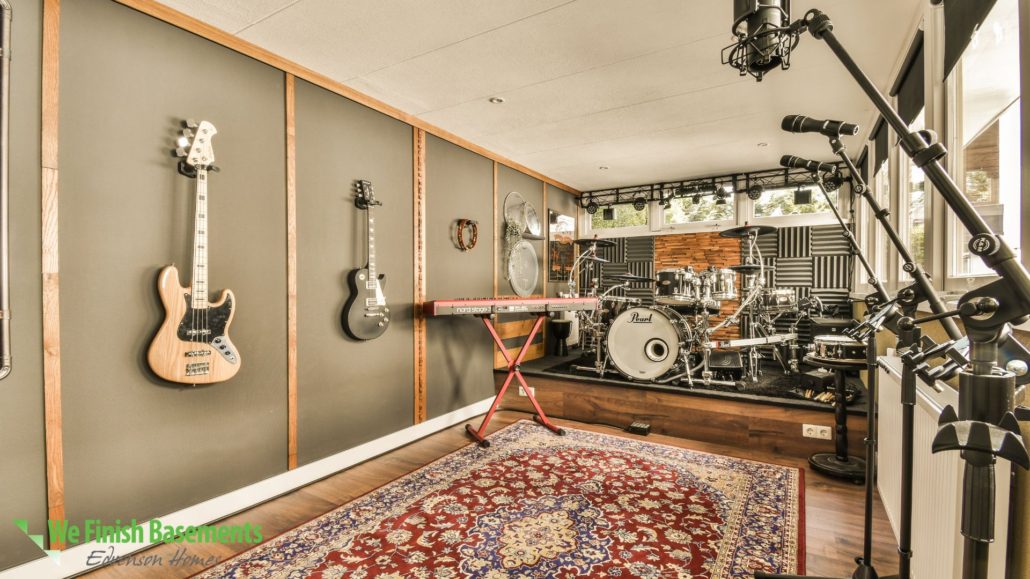
Whether you are setting up a home recording studio, practicing with a full band, or giving your kids a place to play drums without shaking the entire house, building a basement music room is one of the best uses of unused square footage. However, basements present unique acoustic and structural challenges—especially in Minnesota, where concrete foundations, exposed ductwork, and mechanical systems can easily transmit sound throughout the entire home.
1. Understand the Two Types of Sound
Before buying materials, you need to know what kind of noise you are trying to block:
- Airborne Sound: High- and mid-frequency waves that travel through the air, such as vocals, acoustic guitars, and cymbals.
- Structure-Borne (Impact) Sound: Low-frequency vibrations that travel directly through solid building materials (floor joists, drywall, studs, and concrete). Examples include bass guitars, kick drums, and heavy footfalls.
Low frequencies are the hardest to isolate because long sound waves physically move the structure of your home. Effective soundproofing addresses both sound types using four key principles: Mass, Decoupling, Absorption, and Damping.
2. Decouple the Walls and Ceiling (“Room Within a Room”)
Decoupling is the single most effective technique for stopping sound transmission. By physically separating the interior room surfaces from the home’s main framework, you break the path sound vibrations use to travel.
Building Decoupled Walls
In a standard basement finish, wall studs are anchored directly to the concrete floor and top plates are secured to the ceiling joists above. To decouple:
- Staggered Stud Framing: Build a 2×6 top and bottom plate, but stagger 2×4 studs so that alternating studs touch only the interior or exterior drywall.
- Double Stud Walls: Build two separate 2×4 framing walls with a 1-inch air gap between them. This offers maximum isolation for heavy jam spaces.
Isolating the Ceiling
Because your basement ceiling shares joists with the main floor living space, sound easily travels upward. To isolate the ceiling without losing excessive headroom:
- Install Resilient Sound Isolation Clips (RSIC-1) directly to the ceiling joists.
- Snap hat channels (furring channels) into the clips.
- Attach drywall directly to the channels. The rubber mounts in the clips absorb vibrations before they reach the floor above.
3. Add Mass and Acoustic Damping
Heavy materials reflect sound energy, preventing it from passing through. However, stiff mass can still resonate at certain frequencies. Combining heavy mass with a viscoelastic damping compound creates a superior sound barrier.
- Use 5/8-Inch Type X Drywall: Standard drywall is 1/2-inch thick. Fire-rated 5/8-inch Type X drywall is denser and significantly heavier.
- Apply Green Glue Damping Compound: Sandwich a layer of Green Glue (a specialized noise-damping polymer) between two layers of 5/8-inch drywall. Green Glue converts sound energy into heat, drastically reducing low-frequency bass transfer.
- Mass Loaded Vinyl (MLV): If space is tight, hanging a layer of 1 lb/sq ft Mass Loaded Vinyl behind the drywall adds dense mass without taking up precious room width.
4. Insulate Cavities with Rockwool (Mineral Wool)
Empty wall cavities act like acoustic resonance chambers—much like the inside of an acoustic guitar. Filling all wall and ceiling cavities with sound-absorbing insulation stops sound from echoing inside the frame.
Opt for mineral wool insulation (such as Rockwool Safe’n’Sound) rather than standard fiberglass. Mineral wool is denser, offers higher Sound Transmission Class (STC) ratings, provides excellent fire resistance, and is resistant to moisture—an essential feature for basement environments in Minnesota.
5. Treat HVAC, Ductwork, and Flanking Paths
Sound behaves like water: if air can pass through, sound will follow. Ductwork is one of the biggest culprits for leaking noise directly into upstairs living areas.
- Duct Mufflers and Flex Ducting: Replace rigid metal ducting leading into the music room with insulated flexible ductwork or inline duct silencers to eliminate the “speaking tube” effect.
- Seal Air Leaks with Acoustical Caulk: Standard caulk dries hard and cracks over time. Use non-hardening acoustical sealant along all perimeter gaps: where drywall meets floor, ceiling, and adjacent walls, as well as around electrical boxes.
- Acoustic Putty Pads: Wrap the back of all electrical outlets and light switch boxes inside the music room with acoustic putty pads to stop sound leaking through wall penetrations.
 6. Upgrade Doors and Windows
 6. Upgrade Doors and Windows
Hollow-core interior doors act as acoustic strainers. To seal the perimeter:
- Replace hollow doors with a solid core wood door or a specialized sound-rated door.
- Install heavy-duty perimeter weatherstripping and a drop-down bottom door seal to eliminate gaps underneath.
- If your basement has basement egress windows or standard windows, install heavy double-pane glass or custom interior acoustic window inserts.
Professional Basement Soundproofing in Minnesota
Properly soundproofing a basement music space requires exact construction techniques, seamless moisture management, and precise material layering. At We Finish Basements, we design and build custom basement music rooms, home theaters, and jam spaces across Minnesota engineered to keep the music in and the peace upstairs.
Ready to build the ultimate home music space? Contact We Finish Basements today for a consultation and free quote.
FAQ
Can I soundproof a basement music room using egg cartons or foam panels?
No. Egg cartons and soft foam panels are designed for acoustic treatment (reducing echo and reverberation inside the room). They do not possess the mass or structural isolation required to stop sound from escaping into upstairs living areas.
How much ceiling height will I lose when soundproofing a basement ceiling?
Using resilient isolation clips with hat channels and a double layer of 5/8-inch drywall typically consumes about 1.5 to 2 inches of total ceiling height. This provides maximum isolation while preserving critical basement headroom.
What is the difference between soundproofing and acoustic treatment?
Soundproofing prevents sound from entering or leaving a space using mass, decoupling, and sealing. Acoustic treatment controls sound quality within the room using acoustic panels, bass traps, and diffusers to reduce flutter echo and standing waves.
How do I stop low-frequency bass from traveling upstairs?
Stopping low-frequency bass requires structural decoupling (such as resilient sound isolation clips or double stud walls) combined with high-mass materials and viscoelastic damping compounds like Green Glue between drywall layers.


